Tuesday, July 7, 2015

Pittsburgh is a happening place

It seems like 90 percent of Pittsburgh's residents cross the street no matter what color the stoplight. And by the end of four days in the former Steel City (now a center for education, health care, technology) we were crossing against the light and in the middle of the block with the rest of them because we had places to go and things to see.

Other than the Andy Warhol Museum and the City Cafe, mentioned in previous posts, here's a run down of what we did:

--Walked, walked, walked, and walked some more. We never got our car from the hotel parking garage. Nor did we use public transportation. We decided to concentrate on the business district and nearby neighborhoods and walked them to the tune of 30 miles in four days. 

--Gaped at the wonderful architecture. This is the city of Mellon, Carnegie, Frick, Heinz, and other industrialists, and a lot of money went into some beautiful buildings. 

--Visited the warehouse or "Strip" district, a ribbon of land between the Allegheny River and a hillside.  The Strip used to be home to mills and factories. Now it's indoor markets, outdoor markets, bakeries, coffee shops, a fish market, Pittsburgh sports teams memorabilia stores, restaurants, apartments and lofts.

--Went to pubs/brew houses/restaurants. Some faves: East End Brewery Tasting Room on the Strip; Church Brew Works in Lawrenceville (just past the Strip); Ten Penny in the city's cultural district; and Market Square, a park outlined with restaurants. We also went to the Capital Grille at the recommendation of a bartender at Ten Penny; turned out to be way expensive, so we just had soup, salad and dessert. Get the flourless chocolate cake. And the French Onion soup or clam chowder. Maybe in that order. OMG.

--Visited Point State Park, the triangle of land where the Allegheny and Monongahela Rivers meet and become the Ohio River. It was Fort Pitt during the Revolutionary War, then it became a hub of industry and  transportation. By the 1920s it was full of warehouses and railroad yards. Then the Depression hit, there was a flood, and the area was in bad shape.  A state park was created in 1974 and renovations started in 2007. A lovely park.

--Took a narrated paddle boat tour on Pittsburgh's three rivers.

--Road the Monongahela incline, built in 1869 and the oldest cliff railway in the country. Pittsburgh used to have 17 of these hill-climbing machines (technically called "funiculars") but is down to two.

--Visited the Heinz History Center, a affiliate of the Smithsonian and the largest history museum in the state.  Very well done.
Pittsburgh's downtown business district as seen from Mount Washington  across the Monongahela River.
To get to the top of Mount Washington we took the Monongahela Incline, built in 1869 and part of the city's transportation system. It's a cross between a railroad car and a gondola that climbs a set of tracks.
The Andy Warhol Bridge, seen here,  has two "sister" bridges on either side: The Roberto Clemente, named for the right fielder who played 18 season for the Pittsburgh Pirates;  and The Rachel Carson, for the Pennsylvania native, author and environmental activist. The city recently sponsored a survey to see if the bridges should be repainted separate colors.  Pittsburghers said "Keep 'em all Pittsburgh gold." I read that Pittsburgh has 446 bridges. It certainly has a lot, but how can that be possible?
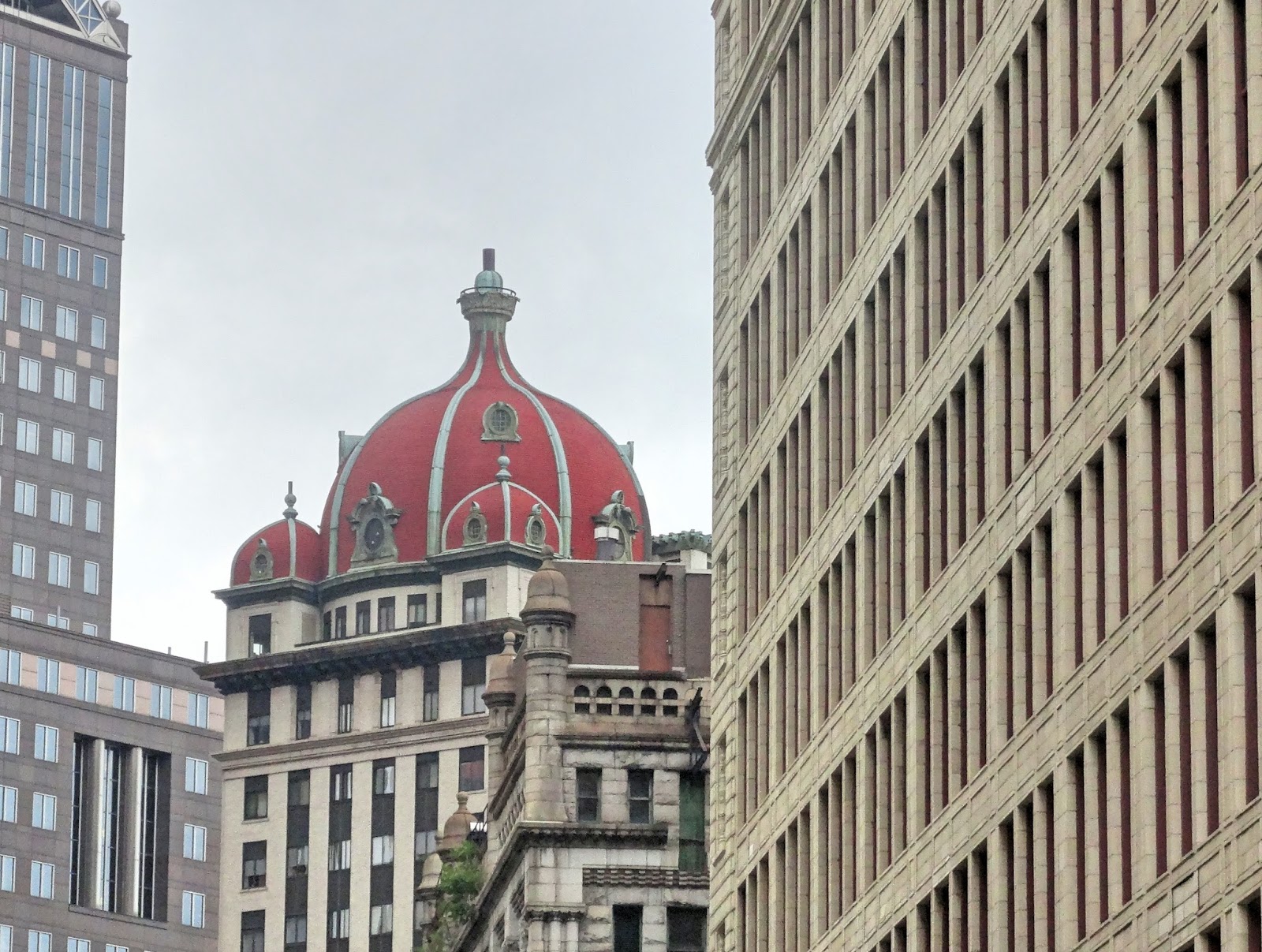
Midtown Towers building is the one with the red dome; the owner of the Pittsburgh Press once lived in a penthouse in the dome.  Formerly known as the Keenan Building, when built in 1907 it was the tallest building in the city. 
The Omni William Penn Hotel, where we stayed. Not quite the same as sleeping in the rig.  I read that an Omni staffer invented Lawrence Welk's bubble machine.  We once put dish washing soap in our RV's black tank and bubbles came out the vent pipe on our roof.  Similarities end there.
The fountain (lower center) is at the confluence of the Allegheny and Monongahela Rivers, and where the Ohio River begins. Point State Park is right behind the fountain.  In 2011 we visited the area where the Ohio River ends in Cairo, Illinois; sadly it's a trashy, weedy field with a dilapidated observation tower.  Get with it, Cairo.  
There was so much to see at the  Heinz History Museum, that when it came to taking a photo I went for the obvious.  But the museum is so much more than ketchup and the Heinz family.  It's the history of what was discovered/invented there like the Salk polio vaccine, Big Mac,  Ferris wheel; its famous people (Mr. Rodgers, George Westinghouse, and of course Carnegie and Mellon); Pittsburgh's sports traditions of the Steelers, Pirates and Penguins; natural history; city history, and on and on. 
Bev at the Church Brew Works, a brewery at the former St. John the Baptist Roman Catholic Church. I'm thinking St. John would approve.
This was built as a bank, not a church. It's the currently-being-restored Union Trust Building, originally organized by wealthy Pittsburgh businessman Andrew Mellon. It's a great example of some of the architectural details we saw in Pittsburgh. 


Sunday, July 5, 2015

Dine if you dare

We like interesting restaurants.  So when we read about City Cafe in downtown Pittsburgh, we knew we had to visit.

Here are some direct quotes from reviews:

“...charming little place with a warm ambiance... marble table tops, classical music in the background, softly lit, tasteful little pictures adorn the walls.”

“I loved this place. Had the huevos rancheros and a latte and both were delicious. Great service and a really pleasant atmosphere.”

“Dude told us to sit at the one table in the restaurant that hadn't been bussed. Then he acted like a pompous ass. We left.”

“STAY AWAY! The owner is an insane man! He locked me and my fiance in the restaurant. I had to call 911 to get out.”

How could we resist? Especially after that last review.

The server -- who is also the owner, cook, dishwasher, table busser and everything else -- told us “It'll be a while” when we walked in, even though there were people at only one other table. The next two couples who wandered in were told “Go somewhere else if you want food.” Two women came in and sat down while Mr. Restaurant was in the back cooking. After a while the women left.

I had a Greek omelet; Jim had the huevos rancheros. Both were great. So I'd recommend this restaurant. Just don’t be in a hurry. Don't go in if more than two tables are full. And I don’t think I’d ask for any substitutions. That didn't cause the "we had to call 911" event described earlier, but you can't be too careful. 


Jim with his huevos rancheros. That's my Greek omelet in front. The owner said he bakes the omelets "like the French do." They were fluffy and very good. 
Wouldn't you want to try this place just by looking at it? The restaurant had just seven tables, was nicely decorated, and violin music played in the background.  While the owner was brusk with us when we first arrived, our service was good.

Friday, July 3, 2015

Uncle Andy Warhol

We've done a lot since we parked our RV in my Mom's driveway in Wellington, Ohio about a month ago.  So I've got some catch-up posting to do. But first I want to talk about our most recent adventure: Pittsburgh, PA.

I haven't been to Pittsburgh since my high school marching band played at a Steelers game. Jim had never been there. So we took Cooper to the dog spa aka kennel, got in the car, and took a road trip. 

One of our standout activities was a visit to the Andy Warhol Museum. The entire building is devoted to the art and life of the man who was born in Pittsburgh in 1928, attended Pittsburgh's Carnegie Institute of Technology (now Carnegie Mellon University), moved to New York City in 1949, and became a pop art icon.

Before the tour I thought of Warhol as odd and “out there” painter of Campbell soup cans who hobnobbed with celebrities and pushed the art envelope. Then we met  Donald Warhola, a Pittsburgh resident, museum board member and staffer, and one of Andy Warhol’s ten nieces and nephews. 

Donald gave a talk before we started our tour, and portrayed Andy Warhol as an involved, generous, and interested uncle  

Donald told us about spending week-long vacations with his uncle in New York City, where he and his cousins played in an attic filled with art and vast collections. He told of sitting in a very fancy chair that Uncle Andy told him once belong to Napoleon. He said his cousins were delighted with a huge chocolate Easter rabbit their uncle game them. And Donald looked forward to getting Uncle Andy's used Levis 501 button-fly jeans -- the jeans were not only hard to get in Pittsburgh but a real fashion statement, especially when they had Andy's paint on them. Andy also gave Donald a job after college when Donald suggested he could help his uncle install computers.

Donald said as children he and his cousins didn't understand their uncle's celebrity, but they did understand how famous some of Uncle Andy's friends were.  When they realized their uncle knew Mick Jagger, for instance, they asked him "How's Mick?"  "Oh he's fine," his uncle replied, turning the subject back to the kids. "How are you doing in school?"

Someone in our group asked Donald why Andy dropped the last letter of the Warhola family name. Donald said he thought it was probably done for a variety of reasons, including dropping the last letter a made it more difficult to tell Warhol's ethnicity as there was discrimination against Slovaks at the time, and because the inability to determine his  ethnicity made Warhol seem more mysterious.

Each floor of the seven-floor museum had art and memorabilia from different decades of Warhol's life. The top floor contained information and photos of Andy's family and his life as a young man. Other floors displayed Warhol's drawings, paintings, portraits  photos, collections, movies, time capsules, and stuff, stuff, stuff, created by this very prolific artist. He had so any items he purchased a former New York City electric substation as a studio and a place to store his art.
The outside of the Andy Warhol Museum. Photography was not allowed inside, otherwise I might  have some crazy and/or beautiful photos in this post. Before Andy's father died, Andy's dad asked older son John to make sure Andy (who was only 13 at the time) went to college because he was going to be something special. John did so.  After Andy's death in 1987, John (who was Donald's dad) was named to the foundation that oversaw Andy's legacy and a was a key player in creating the museum. 
Walking from the museum back to Pittsburgh's downtown business district via the Andy Warhol Bridge.

Wednesday, June 10, 2015

Frank Lloyd Wright: The Weitzheimer-Johnson House

First:  Go Cavs!

And now back to our previous scheduled blog post.

I've only known for a few years that there is a Frank Lloyd Wright house in Oberlin, Ohio. Ever since I found out I've wanted to see it.  But it's used as a guest home for Oberlin College and is only open to the public a few times a year.  This year it's open on seven days.  Last Sunday was one of them and Jim and I made a point to visit.

The building is called the Weitzheimer-Johnson House, and named for the family that built the home and a college professor who restored it. 

Charles Weitzheimer purchased a farming supply business in nearby Wellington and was looking for a home for his family. From what we were told, Mrs. Weitzheimer (Margaret) wrote a letter (around 1947, I think) to architect Wright telling him that she liked his architecture and asked if knew anyone who could design a house similar to those he created -- and do so for only $5,000.  Wright, who was now designing what he believed to be affordable, modern homes (he called them "Usonian") replied that he himself would do it-- but also essentially told them not to expect the house to look expensive.

Mr. and Mrs. Weitzheimer and their four children moved into the home in 1949.  It was sold in 1960 and the new owner plus the next one did some remodeling  -- including painting part of the interior white, and covering some brick walls with wallboard.

In 1970, Oberlin College Art History Professor Ellen Johnson purchased the house with a goal to restore it. She lived in the home until her death in 1992 and willed her home to the college.
The Weitzheimer-Johnson house was the first "Usonian" style home built in Ohio.  Wright used the term Usonian for his vision of homes built with local materials and flat roofs, with an L shape around a garden, and on  inexpensive sites.


Closer view of the home's exterior. The readily available materials that make up this home are  brick (walls), glass (windows), wood (ceilings, trim, and some walls), and concrete (floor). 

View from the house toward the street. Jim says it's "a typical Ohio lawn:"  Huge with no fence.

Wooden spheres lines the entire edge of the roof.  One of the Weitzheimer children said that when she and her three siblings didn't seem to have enough to do, their mother would send them outside to Minwax the spheres.


Our tour guide (standing in the home's living room or "public area" as it was called) was great.  I asked him if he was a professor and he said, no, that his love of architecture and all things Frank Lloyd Wright was an avocation.  You had to take off your shoes as you entered the house or wear booties over your shoes. You can see a few blue-bootied feet in this photo.
Small clerestory windows with a wooden design line most of the upper walls. On the top is the design envisioned by Wright, but the Weitzheimers didn't like it.  A Wright assistant came up with the designed used (on the bottom).

Ceiling of the public space/living room.
Bedrooms and two bathrooms were on the right side of this long hallway.  A bookcase ran the length of the other side.  The hallway floor -- like the rest of the home's floors -- is concrete.  Homes of this type designed by Wright had no "extraneous" spaces such as basements, attics and garages. 

Our tour guide told us that during a remodel the master bathrooms tub was torn out and replaced by a closet.  When Ellen Johnson restored the home, someone told her about a pink tub in local farm field, probably being used to water cattle. It turned out to be original to the house and Johnson reclaimed it.  

Monday, June 8, 2015

Snapping Turtle: Up Close and Personal

The Wellington Reservation, which is part of the Lorain County Metro Parks System and just two miles from my Mom's home in Ohio, is great.  It has miles of hiking paths and we always see lots of animals.  Today's tally included a blue heron, a brilliant scarlet bird, five woodchucks, two deer, a bunch of red wing black birds, and a small black snake.

Saturday, however, we saw something there I've never seen before -- anywhere -- and we saw it up close:  A snapping turtle on land. Laying eggs.

Jim and I rounded a curve on the trail to see a couple with their two daughters watching a big turtle, which was no where near the water and about three feet to the side of the hiking trail.  Mrs. Turtle had dug a hole and was methodically laying eggs about 30 seconds apart.  While I was watching she probably dropped 20 eggs into the ground beneath her.

Jim watched just briefly because it did seem intrusive. I left before she was finished but later saw the couple and their girls; the girls told me the turtle "covered the hole with her hands" when she was finished laying the eggs. I was concerned that once the turtle got out of the throes of labor and realized she was so close to humans, she might scurry off out of fear, so I was glad to hear that.

A line from Wikipedia says, "The common snapping turtle is not an idea pet."  No kidding.  A snapping turtle is not a pet, period.  Had this one not been preoccupied, I doubt that she would have let six people linger four feet away.  They'll usually hiss at people they encounter on land, but this one was focused on the task at hand.
A snapping turtle laying eggs at the Wellington Reservation. The turtle's shell was about 12 inches long.   
The same photo as above, but I lightened the exposure so you can kind of see an egg dropping into the ground behind the rear leg. I read that snapping turtles can lay as many as 40 eggs, which, depending on the temperature, take from nine to 18 weeks to hatch.